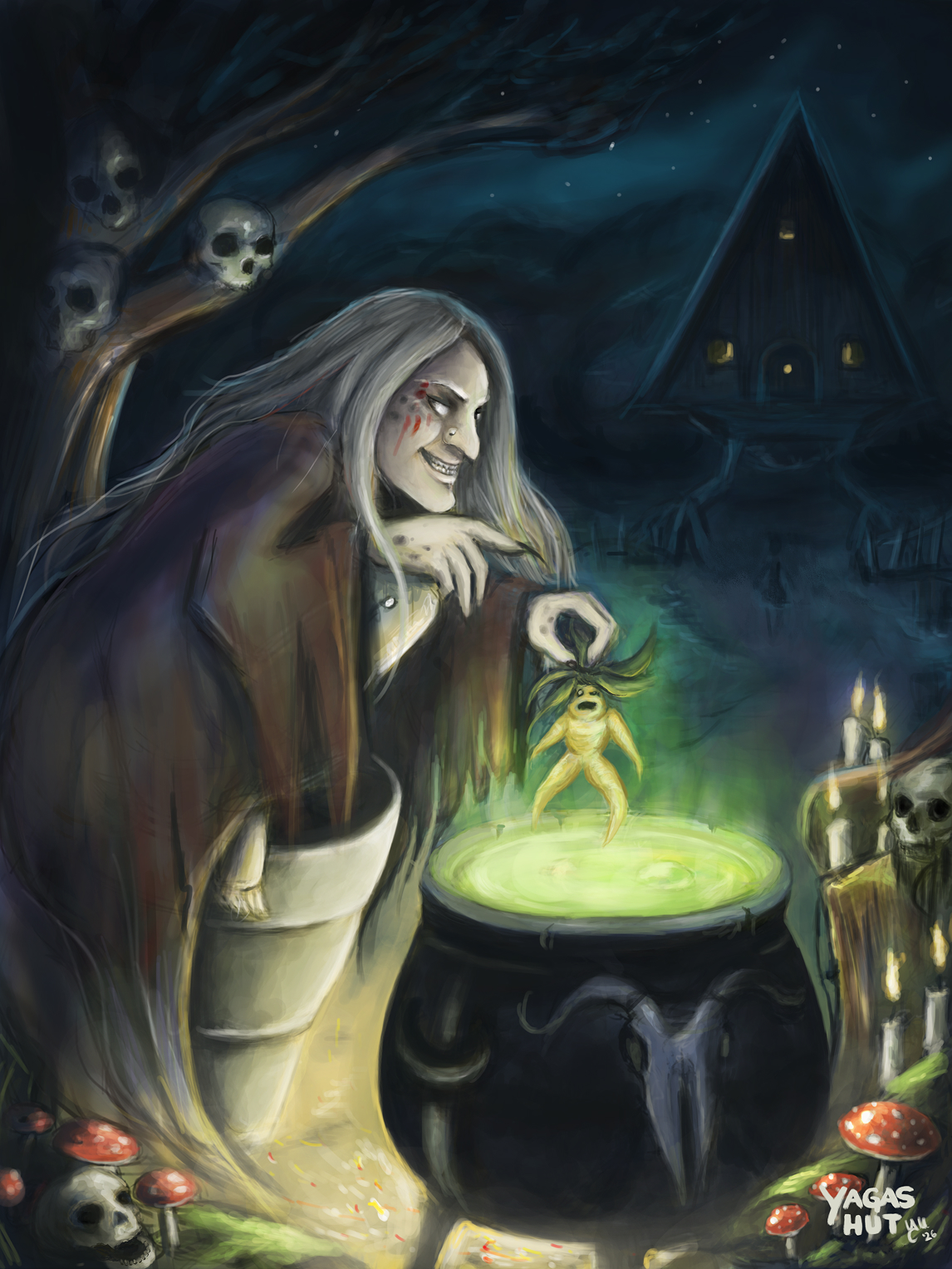


Baba Yaga lives deep within the shadowed forest, one of the most feared and enigmatic figures in Slavic folklore. Far removed from human settlements, she guards ancient knowledge and tests all who dare cross the threshold of her world.
Many feared her, yet others sought her out, believing that only Baba Yaga possessed knowledge of magic, fate, and the hidden workings of the world. She is neither wholly evil nor wholly good. She punishes arrogance, greed, and foolishness, but may reward those who prove themselves worthy through courage, wisdom, and respect.
To stand at Baba Yaga's door is to stand at the boundary between the human world and ancient forces that existed long before humankind.
Appearance & Power
In Slavic folklore, Baba Yaga is described as a haggard old woman with a hooked nose, iron teeth, and a piercing gaze. In some tales, one of her legs is said to be made of bone, earning her the old Russian name Baba Yaga Kostyanaya Noga, or Baba Yaga Bone-Leg. This detail is often interpreted as a sign of her connection to the realm of the dead.
Unlike many witches of European folklore, Baba Yaga does not fly on a broomstick. Instead, she travels through the sky in a large mortar, steering with a pestle and sweeping away her tracks with a broom made of birch branches. In many stories, her arrival is accompanied by fierce winds, strange sounds, and a sudden silence that falls over the forest.
Baba Yaga possesses great knowledge of magic, divination, and the ancient forces of nature. She is not merely a witch, but also a keeper of ancient wisdom who tests all who seek her aid.
She is both a source of fear and a keeper of ancient knowledge, testing all who come to her door.
The Hut on Chicken Legs
One of the most recognizable symbols of Slavic mythology is the hut on chicken legs in which Baba Yaga dwells. According to legend, the hut can move and turn, revealing its entrance only to those who know the proper words:
" Little hut, little hut, turn your back to the forest and your front to me."
The hut is surrounded by a fence of human bones crowned with skulls, their hollow eyes glowing in the darkness. The hut itself seems almost alive: neither entirely a home nor entirely a creature, answering to no one but Baba Yaga herself.
In many stories, the hut represents the boundary between the human world and the realm of supernatural forces. Anyone who crosses its threshold enters a place where different rules apply, and where return is never guaranteed.
Even Leshy, the guardian of the forest, is said in some tales to keep his distance from Baba Yaga's wandering home.
Baba Yaga's hut is more than a dwelling. It is a place where the worlds of humans, nature, and ancient powers meet.
The Story of Vasilisa the Beautiful
Among the many tales of Baba Yaga, one of the most famous is the story of Vasilisa the Beautiful. According to Russian folklore, Vasilisa was sent deep into the forest by her cruel stepmother to seek fire from Baba Yaga, hoping the girl would never return.
Before her death, Vasilisa's mother had given her a small magical doll and instructed her to keep it close. Whenever she found herself in danger or despair, Vasilisa would offer the doll a small piece of food, and in return, it would whisper advice and guidance.
"Feed me, little one, and give me to drink, and I will help you in your sorrow."
On her journey through the forest, Vasilisa encounters three mysterious riders. The White Rider brings the dawn, the Red Rider represents the sun and daylight, and the Black Rider ushers in the night. Baba Yaga later reveals that all three serve her.
When the Black Rider appears, the skulls surrounding Baba Yaga's hut begin to glow.
Upon arriving at the hut on chicken legs, Vasilisa is given a series of seemingly impossible tasks. She must clean, cook, fetch water, and perform countless duties that no ordinary person could accomplish alone.
With the help of the magical doll left by her mother, Vasilisa completes every task. Impressed by her courage, diligence, and respect, Baba Yaga grants her the fire she sought.
Vasilisa returns home carrying a skull lantern burning with an unquenchable flame. According to the tale, this supernatural fire ultimately punishes those who wished her harm.
The story of Vasilisa the Beautiful reminds us that wisdom, courage, and kindness can prevail even against Baba Yaga's greatest trials.
What Baba Yaga Represents
The stories of Baba Yaga are both cautionary tales and sources of wonder. She is far more than a witch from folklore. Baba Yaga is a guardian of thresholds, a symbol of nature's untamed power, life's trials, and the mysteries that exist between good and evil.
To some, she represents doom. To others, transformation, wisdom, and survival. Like the wilderness itself, Baba Yaga remains unpredictable, dangerous, and impossible to fully understand.
To encounter Baba Yaga is never simply to meet a witch. It is to confront something ancient, unknowable, and perhaps even a hidden part of ourselves.


